
A Sales Leader’s Guide to persuasive storytelling…
Insight Article by Robert Hughes
For sales leaders, the Woolworths Customer Offer Reset (COR) creates a familiar challenge: How do you influence the retailer when the retailer’s reassessing the range?
And the question every sales leader should be asking IS NOT, “How do we protect our range?”
Because the future of the range won’t be decided by who makes the best defence of yesterday’s performance.
Instead, ask: How can I make sure that the retailer has a range that best speaks to the shopper, and that I am best placed to be part of that range?
Instead of presenting:
Sales → Market share → Distribution → Margin
Think about building a more complete story:
Shopper need → Product role → Category contribution → Commercial opportunity
The future of the range will be influenced by who can demonstrate a clear understanding of the shopper, a meaningful role in the category, and a credible plan for future growth.
Put the shopper at the heart of the conversation, and build a story the retailer has a reason to believe.
If you’re asking “how do I protect my product”, you’re falling into the trap of going down the brand conversation. If you start from a brand POV, you’re playing their game.
Whereas if you start from a shopper POV, you have a neutral source of truth.
This gets away from those volumetric diagnostics (e.g. share of trade, rate of sales, penetration) and goes to ‘What is the range that suits this shopper? What are the traps that you (as a retailer category manager) aren’t looking at that I can identify for you?” (Then you can bask in their adoration 😊 as you assist them.)
Here are five steps to building a persuasive case…
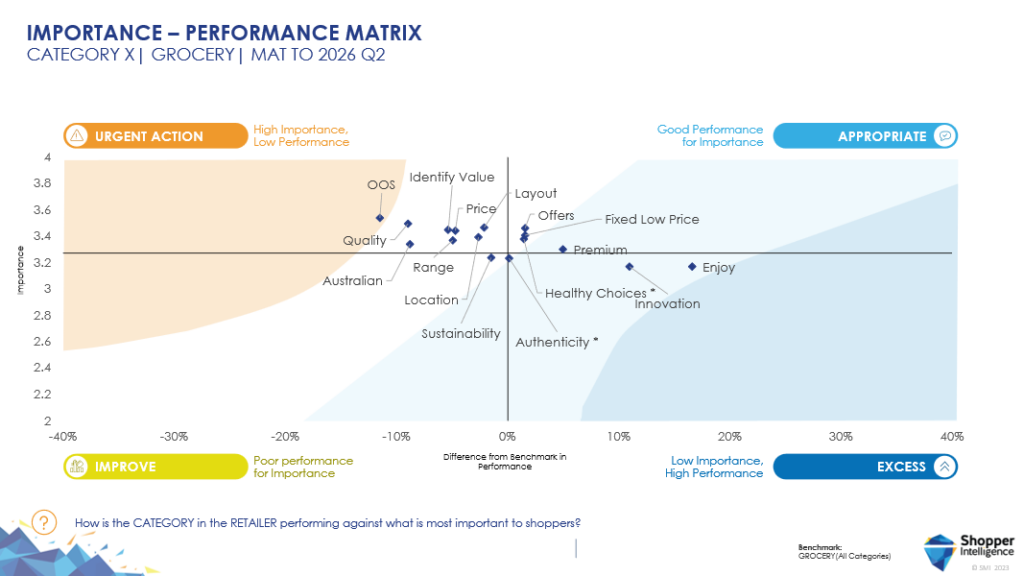
1. Start with Range (one of 17 metrics we analyse to build your case)
Our IMPORTANCE vs PERFORMANCE matrix is an integral part of the planning process for our clients. Are shoppers happy with the Range? And how does it compare with how important the range is to them? There are different actions you’d want to take based on if it’s going well vs poorly. Look at Woolworths separately to other retailers. Then you can compare Range with other priorities, like Layout, or fixed low price, to create a credible story to take to your next meeting.
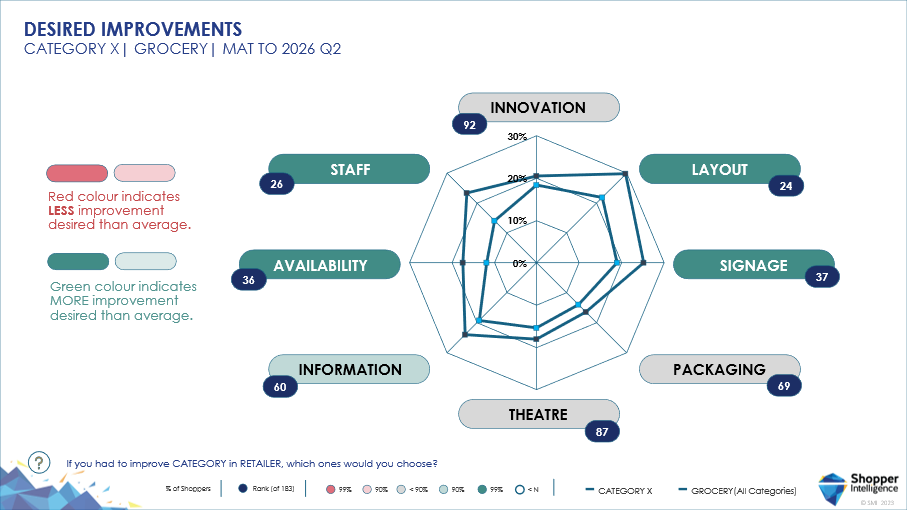
2. Look at Desired Improvements – what factors need to be addressed.
These will show you what have moved from passive frustrations (in What’s Not Performing – above) to active frustrations.
3. Review Category Impact (Differentiation vs Intentionality)
Where is the category in this matrix? Where are the brands? Where are the segments and sizes? What are their roles in the category? Do I have a good mix? Do I have something in every quadrant (or do I want something in every quadrant) ? What is my category’s role in the broader scheme of the aisle and store?
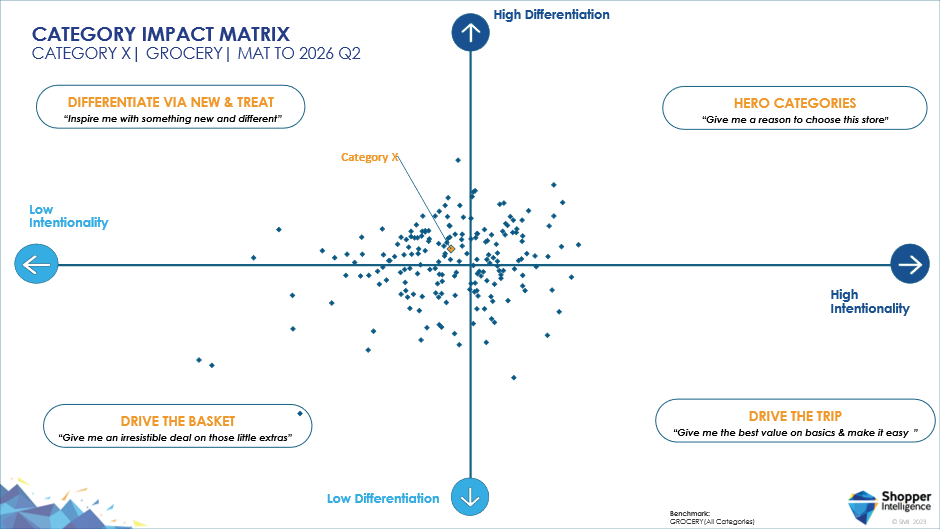
E.g. if the Range (from #1) is coming through as ‘low satisfaction’ but ‘important’, along with other factors such as ‘Innovation’ or ‘Enjoy’, and there’s nothing in #3 from a ‘treat’ perspective, I may need more products that speak to ‘surprise and delight’ at shelf.
Do you have the right brands in your category to fulfil what shoppers aren’t getting?
What is the role of each brand? How can the retailers make a change that’s going to least impact what’s going well.
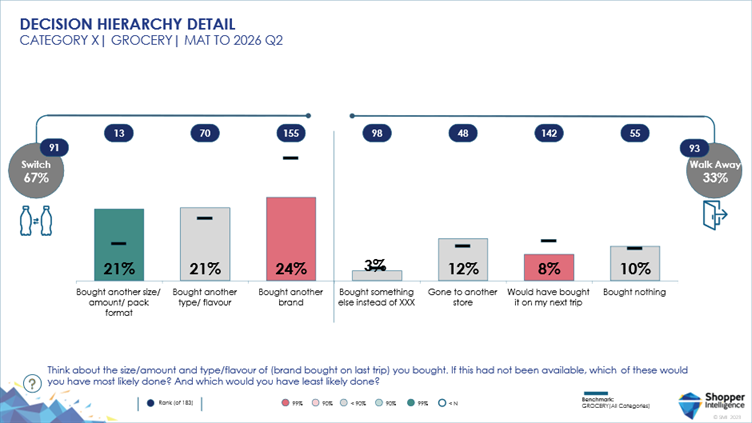
4. Other perspectives to quantify it: Decision Hierarchies…
Do you want to cull Brands or Sizes? In this example you’d probably not want to cull brands because in this category shoppers don’t want to swap brands. They want to swap flavours or packsizes if the product wasn’t available. This is when you could bring in other metrics (e.g. demographics). It’s about “Let’s be smart about what we’re culling to least affect the shopper taking into account how they’re engaging with the category.”
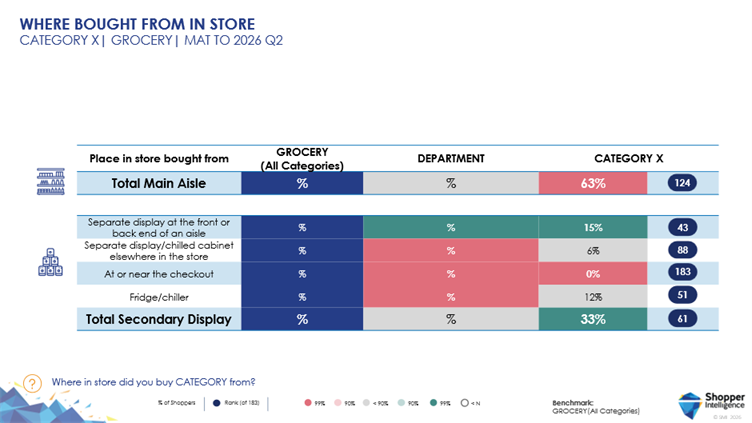
5. You’ll want to split ‘Main Aisle’ shoppers from ‘off-location’ shoppers in your category review
…Because main aisle shoppers are making the choice with all the options in front of them. (Shopper Intelligence can also assist with which brands work best in an off-location or gondola end display).
If in any doubt… go back to ‘who’s the person walking down the aisle.’ – That’s the most important thing.
Speak to a member of the Shopper Intelligence team for guidance on your categories.